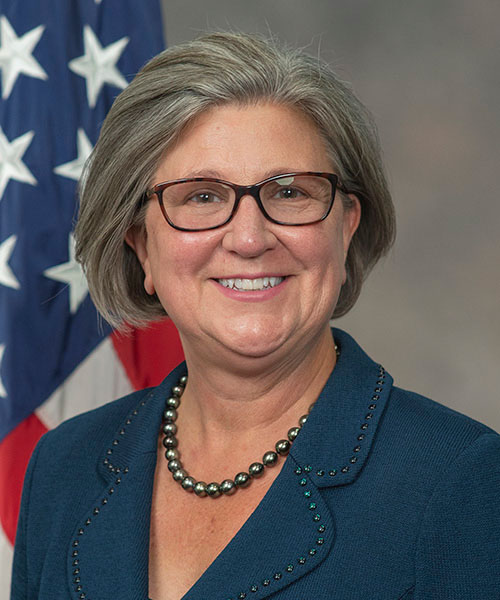
Stacie Williams
Chief Science Officer of the United States Space Force (USSF)
Dr. Stacie Williams, a Senior Level executive, is the Chief Science Officer of the United States Space Force (USSF). She serves as the central lead for all science and technology matters for an organization that comprises approximately 14,000 space professionals worldwide. In this role, she develops long-term military requirements for the USSF and interacts with other principals, operational commanders, combatant commands, acquisition organizations, and international communities to address cross-organizational science and technical issues and solutions. Dr. Williams represents the USSF science and technology community across the U.S. government, industry, academia, the international community, and other scientific and technology organizations.
Dr. Williams joins Headquarters, USSF from the Air Force Research Laboratory (AFRL), where she was the Space Science Architect for the Air Force Office of Scientific Research (AFOSR). At AFOSR, Dr. Williams led the basic research investment strategy for space, ensuring that basic science investments effectively met USSF mission needs. In prior assignments, she led AFOSR’s remote sensing research portfolio as well as AFRL’s space imaging portfolio. Dr. Williams served as a program manager at the Defense Advanced Research Project Agency (DARPA) Tactical Technology Office, where she led a portfolio focusing on remote sensing, small satellite technologies, and high-energy laser detection.
Dr. Williams entered government service in 2011 at AFRL’s Directed Energy Directorate, and spent several years as the Technical Advisor at the Air Force Maui Optical and Supercomputing Site, leading researchers and operators in developing and transitioning the world’s only 24-hour resolved imaging capability, in addition to other space domain awareness technologies.
Quantum Computing Using Electron Spins in Si/SiGe Gate-Define Quantum Dot
Remarkably, the techniques to make classical silicon CMOS devices can be used to make qubits. The operation of these devices is very different from advanced classical integrated circuits. In this talk I will present a historical overview of quantum computing in silicon and the latest results from my group.